Best Pulse Oximeter for Seniors With Cold Hands

Six fingertip oximeters lined up by display type, reading speed, published warranty and what the listings actually promise about low-perfusion fingers.

By Hannah PooleUpdated 16 min read
On this page
- Best pulse oximeter for seniors at a glance
- How I screened these six down and what each criterion was worth
- Why cold fingers, not accuracy claims, decide this purchase
- 1. Zacurate 500 Series 500DL — Best overall
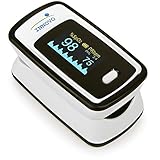
- 2. Innovo Deluxe iP900AP — Best premium
- 3. Healthtree JKS50B — Best warranty
- 4. Zacurate 500BL — Most versatile
- 5. HealthTree Fingertip Oximeter — Best budget pick
- 6. Berrcom Finger Pulse Oximeter — Best upgrade
- LED or OLED: which display suits older eyes?
- What does the perfusion index actually tell you?
- What the listings leave out
- The verdict
- FAQ
The best pulse oximeter for seniors is the Zacurate 500 Series 500DL, because it returns SpO2 and pulse in 10 seconds on a large LED display, weighs 3.2 oz and ships with a silicone cover, lanyard and two AAA batteries. If you want an audible alarm and a perfusion reading instead of the simplest possible one-button device, the Innovo Deluxe iP900AP is the better buy.
Here's the trap. Most buyers compare accuracy percentages between these units. That figure barely separates them, and it isn't what fails an older user at 6am in a cold bedroom.
Best pulse oximeter for seniors at a glance
| Pick | Display | Reading time | Price |
|---|---|---|---|
Best overall Zacurate 500 Series 500DL |
Large LED | 10 seconds (claim) | Check Price |
Best premium Innovo Deluxe iP900AP |
LED, adjustable brightness | Not stated | Check Price |
Best warranty Healthtree JKS50B |
Large OLED | 5-8 seconds (claim) | Check Price |
Most versatile Zacurate 500BL |
Large LED | 10 seconds (claim) | Check Price |
Best budget pick HealthTree Fingertip Oximeter |
OLED | Not stated | Check Price |
Best upgrade Berrcom Finger Pulse Oximeter |
Large LED | 8 seconds (claim) | Check Price |



How I screened these six down and what each criterion was worth
I weighted four things, in this order, when I lined up the published specifications side by side.
- Readability, worth the most. A device that gives a correct number nobody can read is useless. That means display type, digit size and whether the screen faces the user rather than the ceiling.
- Operation simplicity, second. One button, no menu tree, no pairing step. Anything that needs a phone or an app was cut from consideration for this list.
- Published warranty and support, third. Four of these six state a one-year term. One of them also states USA-based phone support, which matters more to an older buyer than it does to a hiker.
- What's in the box, fourth. Batteries pre-loaded beats batteries included, and batteries included beats a trip to the store on day one.
Why that order? Because it mirrors the failure sequence. The first thing that goes wrong is a squinting user misreading an 8 as a 9. The second is a device with a settings mode nobody understands. The third is a unit that dies in month seven with nobody to call.
What that weighting cost the field: the Berrcom lands last here not because its claims are weak but because its listing publishes only colour and count. No weight, no dimensions, no warranty term, no model number. I can't weigh what isn't written down.
Why cold fingers, not accuracy claims, decide this purchase
Every one of these six claims accuracy. The Healthtree JKS50B states ±2%. Berrcom cites photoelectric sensing and a high-performance chip. Zacurate says 10 seconds to a reading. Those claims cluster so tightly that they don't separate the field.
What separates the field is low perfusion. A fingertip oximeter works by shining light through the finger and reading what comes out the other side. When circulation at the fingertip is weak, the signal weakens with it. Cold hands, thin skin, Raynaud's, certain medications, poor peripheral circulation: all of these are more common in older adults, and all of them push a device toward a slow reading, an unstable reading or no reading at all.
Only one listing in this set addresses that directly. Innovo says the iP900AP uses an improved LED and sensor "allowing SpO2 and pulse rate measurement even at low blood perfusion". That is the manufacturer's claim, not a measured result, but it's the only claim in the six that names the actual problem.
Two picks publish a perfusion index. The Innovo iP900AP and the Healthtree JKS50B both list it. That number tells you how strong the signal was, which tells you whether to trust the reading you just got. Everything else in this set gives you a bar graph or a waveform and leaves you to judge.
Here's the practical version. Warm the hand first. Sit still. Read the signal indicator before you read the number.
1. Zacurate 500 Series 500DL — Best overall
The 500DL is the best pulse oximeter for seniors here because it does the fewest things and makes all of them easy to see.
Best for: an older adult who wants one button, a big glowing readout and batteries already in the box Skip it if: you need an audible alarm or a waveform trace
Zacurate published this model in 2019 and the specifications are unusually complete for the category: 3.2 oz, 1.25 x 2.25 x 1.25 in, model 500DL, one-year warranty. That completeness is itself a signal. Two picks in this set don't publish a weight at all.
The differentiator inside this group is the accessory bundle. It's the only one of the six whose listing names a silicone cover alongside the batteries and lanyard. For a device that lives on a nightstand and gets knocked to a hardwood floor, that cover is worth more than a spec sheet line suggests.
Zacurate claims a reading in 10 seconds on a large digital LED display, and says the display faces the user for an easy read. The company also claims this is the only LED oximeter that reads SpO2 up to 100%. Treat that as marketing language, not verified fact. The finger chamber uses what Zacurate calls a SMART Spring System, rated for ages 12 and above.
The trade-off: it's the second-most-expensive pick here, and it gives you no alarm, no perfusion index and no adjustable brightness. You're paying for simplicity and a protective case, not features.
Pros:
- Complete published specifications including 3.2 oz weight
- Only pick listing a silicone protective cover
- 10-second reading claim on a large LED display
- One-year warranty stated
- Display oriented toward the user
Cons:
- No audible alarm for out-of-range readings
- No perfusion index to judge signal quality
- Second-highest price position in this set
- Rated for ages 12 and up only
2. Innovo Deluxe iP900AP — Best premium
The iP900AP is the only pick in this set whose listing claims it can read a finger with poor circulation.

Best for: someone tracking oxygen daily who wants an alarm and a perfusion reading Skip it if: extra menus and settings will confuse the user
This is the most expensive pick here, and the reason is the feature list rather than the build. Innovo says the iP900AP carries an improved LED and sensor for measurement at low blood perfusion, plus a plethysmograph waveform and a perfusion index to confirm the reading is real. Those are the manufacturer's claims. They're also the only claims in this group aimed squarely at the fingertip problem older users actually run into.
Three additions set it apart from the four simpler units. An auditory alarm. Pulse detection beeps. Adjustable display brightness. That last one matters for a device used in a dark bedroom, where a fixed-brightness LED can be genuinely dazzling.
Published dimensions are 1.25 x 2.5 x 1.35 in, making it the longest body in the set by a quarter inch. No weight is listed. The 2020 release comes with a one-year manufacturer warranty, two AAA batteries and a lanyard. The model designation reads "without Bluetooth", so don't expect phone syncing.
Against the Zacurate: no silicone cover, no published weight, no stated reading time, and more buttons and settings for a user who may want none of them.
Pros:
- Only listing claiming low-perfusion measurement
- Perfusion index and plethysmograph waveform included
- Adjustable brightness suits dark rooms
- Audible alarm plus pulse detection beeps
- One-year manufacturer warranty stated
Cons:
- Highest price position of the six
- No published weight figure
- No stated reading time
- More settings to learn than the one-button picks
- No protective cover in the box
3. Healthtree JKS50B — Best warranty
The JKS50B publishes the fastest reading time and the only hard accuracy figure in this group.

Best for: a caregiver who wants the fastest published reading time in this set Skip it if: you prefer a red LED readout you can see across a dim room
Two numbers make this pick interesting. HealthTree claims a reading in 5-8 seconds, which is the quickest figure published across all six, and states ±2% accuracy, which is the only numerical accuracy tolerance any of these listings gives. Both are the manufacturer's claims. Neither is independently verified. But a stated tolerance is more useful than a vague promise of precision, and I'd rather have a number to hold a brand to.
It also lists a perfusion index, putting it alongside the Innovo as one of only two picks here that report signal quality. That's a genuine advantage for anyone with cold hands, and it costs considerably less than the Innovo.
The display is a large OLED showing SpO2, pulse rate, signal strength and a waveform bar graph. Batteries come pre-installed, which is a small kindness the other listings don't mention. Published dimensions are 1.25 x 2.25 x 1.2 in, with a one-year manufacturer warranty and one-button operation. This is the slowest-moving pick of the top five.
The catch: no published weight, and OLED readouts are typically dimmer than the red LED alternatives when you're looking at them from across a room.
Pros:
- Fastest published reading time at 5-8 seconds
- Only pick stating a ±2% accuracy tolerance
- Perfusion index for signal confirmation
- Batteries pre-installed out of the box
- One-year manufacturer warranty
Cons:
- No published weight figure
- OLED harder to read at a distance than red LED
- Sells slower than four of the other picks
- No protective cover included
4. Zacurate 500BL — Most versatile
The 500BL is the pick I'd hand to a household passing one device between several adults.
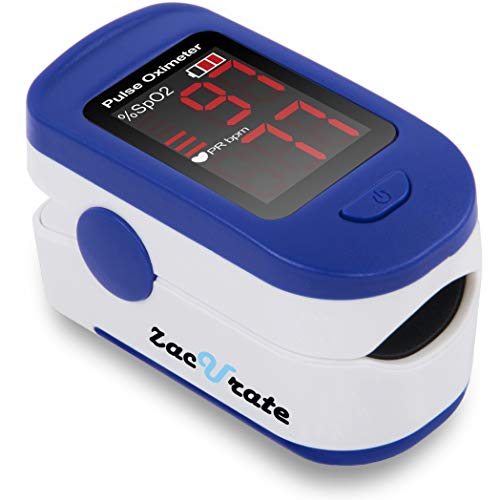
Best for: a household passing one unit between several adults Skip it if: the user is under 12 or has very slim fingers
Released in 2017, the 500BL is the oldest design in this set and the second-cheapest pick. It's also the only one whose listing names USA-based technical phone support alongside its 12-month warranty. If the person using this device would rather call a human than email a form, that line is the whole argument.
Zacurate claims a 10-second reading on a large LED display facing the user, with the same SMART Spring finger chamber as the 500DL and the same rating for ages 12 and up. Published dimensions are 1.3 x 2.1 x 1.1 in, and it's the heaviest unit here at 4 oz. That extra weight is not a flaw at this scale. A slightly denser body sits more securely on a finger and is easier to pick up off a table with arthritic hands.
The colour is Light Navy Blue, which is worth a passing thought in a household with two units and two people. A different-coloured shell is the cheapest labelling system there is.
Set against its own sibling, the 500DL: no silicone cover, no 100% SpO2 claim, an older design year. What you lose in accessories you gain in price position.
Pros:
- Only listing naming USA-based phone support
- 4 oz body easier to grip than lighter units
- 12-month warranty stated
- Second-cheapest of the six
- Batteries included for day-one use
Cons:
- No silicone protective cover in the box
- Oldest design in the set at 2017
- No perfusion index or alarm
- Not rated for anyone under 12
5. HealthTree Fingertip Oximeter — Best budget pick
This is the cheapest of the six and the sensible answer when you need a second unit rather than a better one.

Best for: a second unit for a bedside table or a travel bag Skip it if: you want the extra protection of a silicone case
Two devices beat one device you can never find. A lot of households end up wanting a bedroom unit and a handbag unit, and this is the cheapest way to get the second one without dropping to an unknown brand.
It shares the JKS50B model designation and the same 1.25 x 2.25 x 1.2 in footprint, with a gray shell instead of black. HealthTree describes a bright OLED screen with large digits showing SpO2, pulse rate and signal strength, plus a waveform bar graph for visual confirmation of pulse strength. Operation is a single button: insert finger, press, read. The box holds the oximeter, two AAA batteries, a lanyard and a manual, and the warranty is one year from the manufacturer.
Notably, this listing does not publish the 5-8 second reading time, the ±2% figure or the perfusion index that its black-shelled counterpart does. Same model code, thinner claims. I'd treat the two as close relations rather than identical twins, and buy the one whose published claims you actually need.
The trade-off is straightforward. Cheapest price position in the set, thinnest published spec sheet among the five that publish anything, and no protective cover.
Pros:
- Cheapest pick in this set
- Large-digit OLED with signal strength shown
- One-button operation, no menus
- Batteries, lanyard and manual included
- One-year manufacturer warranty
Cons:
- Fewer published claims than the identically-coded JKS50B
- No stated reading time or accuracy tolerance
- No perfusion index
- No weight published and no silicone cover
6. Berrcom Finger Pulse Oximeter — Best upgrade
Berrcom is the only listing here that names seniors directly, and the only one that publishes almost nothing else.

Best for: a household checking several family members with one device Skip it if: you want published weight, dimensions or warranty before you buy
The feature list here reads well. Berrcom claims photoelectric sensing for precise readings, advanced algorithms and a high-performance chip producing a stable result in 8 seconds, one-button measurement and a large digital LED display. It also states the widest user range of any pick in this set: children, adults, seniors and pregnant women. Four of the six restrict themselves to ages 12 and up or say nothing on the matter.
That breadth is a real advantage in a multi-generational household. One device on the shelf, no age caveat to remember.
Then the spec sheet runs dry. Colour: black. Count: 1. That's the entire published specification. No weight. No dimensions. No warranty term. No model number. No release year. Every other pick here publishes at least a warranty and a footprint. I won't fill those gaps with guesses, and neither should you when you're buying a health monitor for an older relative.
It's also the slowest-moving pick of the six by a wide margin. Sitting mid-range on price with the thinnest published data behind it makes this the pick I'd take last, despite the appealing claims.
Pros:
- Only listing naming seniors and children explicitly
- 8-second reading claim with one-button operation
- Large digital LED display
- Widest stated user range in this set
Cons:
- No published weight, dimensions or model number
- No warranty term stated anywhere in the listing
- Slowest-selling pick of the six by a large margin
- Mid-range price position with the thinnest data behind it
LED or OLED: which display suits older eyes?
This is the split that runs straight through the six, and it's the one most guides skip.
Red LED, used by the Zacurate 500DL, the Zacurate 500BL, the Innovo iP900AP and the Berrcom, produces glowing segmented digits. They're visible from across a dim room and they don't need ambient light. The digits are typically chunky. The downside: segmented displays can only show numbers and simple bars, and a fixed-brightness LED in a dark bedroom is genuinely uncomfortable to look at. Only the Innovo lists adjustable brightness.
OLED, used by both HealthTree units, draws finer detail. That's how those two fit a waveform bar graph and, in the JKS50B's case, a perfusion index onto the same 1.25 x 2.25 in body. The images are sharper. Contrast in bright daylight is usually better. But OLED digits are generally smaller than LED segments at the same screen size, and less visible from a distance.
The practical rule I'd apply:
- Failing eyesight, dim bedroom, glasses left on the dresser: pick red LED.
- Wants the extra data on screen, reads it up close, checks in daylight: pick OLED.
- Both, in the same household: buy one of each and colour-code them.
What does the perfusion index actually tell you?
A perfusion index is a measure of how strong the blood flow through your fingertip was during the reading. It's not a health score. It's a confidence score for the number sitting next to it.
Two picks publish one. The Innovo iP900AP and the Healthtree JKS50B. That's it out of six.
Why should a senior buyer care? Because the most common failure with these devices isn't a wrong number, it's a number produced from a signal too weak to support it. Cold hands. Thin skin. Nail polish. A hand that moved. Any of those can yield a plausible-looking reading that means nothing. A perfusion figure lets you spot that before you act on it.
The four picks without one still give you something. All six show either a signal strength indicator or a waveform bar. A steady, rhythmic bar means the device found a clean pulse. A jumpy or flat one means try again.
Either way, the routine is the same. Warm the hand. Rest it on a table. Wait until the display settles. Then read.
What the listings leave out
Three gaps run across all six of these listings, and knowing them saves a return.
Battery life. Every one of these units ships with two AAA batteries. Not one publishes how many readings that buys you. Assume you'll want spares in the drawer.
Auto shut-off. Most fingertip oximeters power down after a period without a finger in the chamber. None of these six states the timeout. If the user forgets to remove it, that matters.
Finger sizing. Both Zacurate models name a SMART Spring System accommodating a range of finger sizes, and both restrict use to ages 12 and up. The Berrcom claims children through seniors. The two HealthTree units describe compact one-button operation without giving a size range. If the intended user has very slim or very swollen fingers, none of these listings gives you a measurement to check against.
What none of them is. These are consumer wellness monitors. Not one of these listings claims medical-device certification, and I'd read no such claim into the specifications. A number from any of the best pulse oximeter for seniors picks here is a data point to bring to a clinician, not a diagnosis.
The verdict
Three tiers, and the price positions in this set map onto them cleanly.
At the entry end, the Zacurate 500BL is the pick, and it's the one I'd choose without much hesitation for a straightforward case. A large user-facing LED, a 10-second reading claim, 4 oz of grippable body, a 12-month warranty and USA-based phone support. The cheaper HealthTree unit exists for households wanting a second device rather than a first one.
In the middle, the Healthtree JKS50B earns its place on two published numbers nobody else matches: a 5-8 second reading and a ±2% accuracy tolerance, with a perfusion index alongside. The Berrcom sits at a similar price position with the thinnest spec sheet in the group, which is why it lands last.
At the top, the Zacurate 500DL takes the overall win. It's the most complete package here for an older user: full published specifications, a silicone cover no rival lists, batteries and lanyard, and the fewest ways to get confused. The Innovo iP900AP costs more and beats it on exactly one axis that matters, and it's the axis to weigh carefully. If cold hands or weak circulation are part of the picture, the iP900AP's low-perfusion claim and its perfusion index are worth the extra outlay and the extra buttons. Otherwise the simpler device wins.
FAQ
Is the best pulse oximeter for seniors worth buying at all?
A pulse oximeter for seniors is worth buying if a clinician has asked for home oxygen readings, or if a lung or heart condition means trends matter. It's a data point, not a diagnosis. None of these six listings claims medical certification. If nobody has asked you to track SpO2, the number will mostly just create questions you can't answer.
What makes one pulse oximeter better value than another here?
Better value in this set comes down to published claims per dollar. The Zacurate 500BL sits at the second-cheapest position while stating a warranty, phone support, a weight and a reading time. The Berrcom sits mid-range publishing only colour and count. Same category, very different amounts of information behind the purchase.
Will a fingertip oximeter work on cold or poorly circulating fingers?
Cold or poorly circulating fingers are exactly where these devices struggle, because they read light passing through the fingertip. Warm the hand first, rest it on a table and stay still. The Innovo iP900AP is the only listing here claiming measurement at low blood perfusion, and it plus the Healthtree JKS50B are the only two publishing a perfusion index.
Zacurate 500DL or Innovo iP900AP: which should I choose?
Choose the Zacurate 500DL if simplicity wins: one button, a large user-facing LED, 3.2 oz, a silicone cover and complete published specs. Choose the Innovo iP900AP if you want the audible alarm, adjustable brightness, perfusion index and its low-perfusion sensor claim. The Innovo costs more and asks the user to learn more settings.
What mistake do people make buying a pulse oximeter for seniors?
The mistake buying a pulse oximeter for seniors is chasing accuracy percentages instead of readability and grip. All six of these claim precision. What actually fails is a squinting user misreading small digits, a dazzling fixed-brightness screen at night, or a device too light and slippery to pick up with stiff hands.
Start by asking one question about the person who'll use it: can they read the screen without hunting for glasses? If the answer is no, buy red LED and buy the Zacurate 500DL. Everything else in this category is a refinement on top of that. The 500DL wins here not because it does the most but because it removes the most ways to go wrong: batteries already in the box, one button, big glowing digits pointed at the user's face, and a silicone cover for the inevitable drop onto a hardwood floor. Warm the hand, sit still, write the number down.