Best Pulse Oximeter for Athletes by Spec and Feature

Seven fingertip pulse oximeters compared on spec, warranty, weight and what the listing actually tells you. The Zacurate 500DL leads on published detail; three others win on specific conditions.

By Hannah PooleUpdated 15 min read
On this page
- Does the athlete label actually mean anything here?
- Best pulse oximeter for athletes at a glance
- How I screened seven listings down to the picks
- What the specifications actually decide
- 1. Zacurate 500 Series 500DL — Best overall
- 2. Innovo Deluxe iP900AP — Best premium
- 3. Vibeat Fingertip Pulse Oximeter — Best for pros
- 4. HOLFENRY Pulse Oximeter — Runner-up
- 5. Zacurate 500BL — Best upgrade
- 6. HealthTree JKS50B — Best minimal setup
- 7. HealthTree Fingertip Pulse Oximeter — Best budget pick
- Reading SpO2 during and after training
- What the listings do not tell you
- The verdict
- FAQ
The best pulse oximeter for athletes here is the Zacurate 500 Series 500DL, because it pairs a 10-second SpO2 reading with the fullest published spec sheet in this set: 3.2 oz, a 1-year warranty and a silicone cover that survives a gym bag. If you want an audible alarm and perfusion index on the display, the Innovo Deluxe iP900AP is the better buy.
Does the athlete label actually mean anything here?
Amazon returned seven fingertip oximeters when I searched for a pulse oximeter for athletes, and none of the seven publishes a spec that specifically qualifies it for sport. There is no waterproofing figure. No motion-tolerance rating. No sweat-resistance claim. Every listing mentions climbers, skiers or cyclists in its marketing bullets, but the underlying hardware is the same fingertip clip you'd buy for a bedside table.
That matters because it changes what you're actually choosing between. A pulse oximeter for athletes, in practice, is a general fingertip oximeter with three useful traits: a fast reading so you can check between sets, a display you can see outdoors, and a case or lanyard so it survives being tossed in a bag. The picks below are ranked on those traits and on the published specifications, not on any listing's claim to be built for sport.
One more thing before the table. If you want continuous SpO2 during a run or ride, none of these fits the job. They're spot-check devices. A chest strap or a wrist wearable with SpO2 is a different category.
Best pulse oximeter for athletes at a glance
| Pick | Reading speed | Extras on display | Price |
|---|---|---|---|
Best overall Zacurate 500DL |
10 seconds claimed | SpO2, pulse, pulse strength | Check Price |
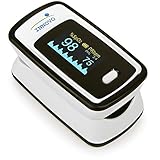
Best premium Innovo Deluxe iP900AP |
Not stated | Plethysmograph, perfusion index, alarm | Check Price |
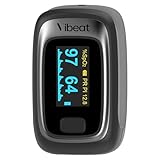
Best for pros Vibeat Fingertip |
30s spot check | Threshold alerts, 12 saved readings | Check Price |
Runner-up HOLFENRY JKS50BL |
5-8 seconds claimed | SpO2, pulse, perfusion index | Check Price |
Best upgrade Zacurate 500BL |
10 seconds claimed | SpO2, pulse, pulse strength | Check Price |
Best minimal setup HealthTree JKS50B |
5-8 seconds claimed | SpO2, pulse, waveform, PI | Check Price |
Best budget pick HealthTree JKS50B (OLED) |
Not stated | SpO2, pulse, waveform | Check Price |



How I screened seven listings down to the picks
Three reasons a listing got cut lower in the ranking. First, missing spec fields: Vibeat and HOLFENRY do not publish a weight, and neither does the HealthTree JKS50B. That's not a fatal flaw for a device this small, but it's a data hole a competitor closes for the same money. Second, missing warranty text: the Vibeat and HOLFENRY listings do not state one, while every Zacurate, Innovo and HealthTree listing here publishes a 1-year manufacturer warranty. Third, thin display information: some listings promise a "5-8 second reading" and others promise a "10-second reading" and one gives no time at all.
What survived the cut share three traits: an SpO2 and pulse rate output, batteries in the box, and a lanyard. Those three are the floor here, not a differentiator. Above that floor, the picks split by what they add: perfusion index, waveform, alarm, saved readings, or a protective case.
What the specifications actually decide
Reading speed is the specification most buyers overweight. A 5-second reading versus a 10-second reading is not what decides this. You are standing still with a finger in a clip either way, and both times are shorter than tying a shoelace. What decides it is what appears on the screen and what protects the unit between checks.
- Perfusion index tells you whether the reading is trustworthy on a cold or vasoconstricted finger. Present on the Innovo iP900AP, the HOLFENRY and the HealthTree JKS50B listings.
- A waveform or plethysmograph gives visual confirmation the pulse the device is tracking is real. Present on the Innovo, both HealthTree models and the HOLFENRY.
- An audible alarm with a threshold you set matters if you're using it during recovery. Present on the Innovo and the Vibeat.
- A case or cover is the difference between a device that lives in a gym bag and one that stays on a shelf. Only the Zacurate 500DL publishes a silicone cover.
Weight is close to a wash. Where it's published, these devices sit between 3.2 oz and 4 oz. Dimensions cluster around 1.25 x 2.25 x 1.2 in, with the Vibeat and HOLFENRY running slightly larger.
1. Zacurate 500 Series 500DL — Best overall
The 500DL is the pick because it publishes the fullest spec sheet in this set and ships with a silicone cover no other pick includes.
Best for: an active adult who wants the fullest spec sheet and a silicone case for the gym bag Skip it if: you want stored history or Bluetooth to a phone
Zacurate publishes what many competitors here leave blank: a 3.2 oz weight, a 1.25 x 2.25 x 1.25 in footprint, a 2019 release date and a 1-year warranty. Zacurate also claims a 10-second SpO2 and pulse rate reading, and says the 500DL is the only LED pulse oximeter in its line that reads and displays SpO2 up to 100%. The finger chamber uses what Zacurate calls a SMART Spring System, rated for ages 12 and up, which is the accommodation range that matters if a device gets shared across a household. The bundle covers the practical gaps: two AAA batteries in the box, a lanyard, and the silicone cover.
The trade-off is what the 500DL leaves off. There is no perfusion index. No waveform. No saved readings, no threshold alarm, no Bluetooth. If you want the numbers a clinician would look at second, the Innovo below has more of them.
Pros:
- Silicone cover included, unique in this set
- 3.2 oz, the lightest weight published here
- 1-year warranty with USA phone support
- 10-second reading claim
- Batteries and lanyard in the box
Cons:
- No perfusion index
- No stored history or alarm
- The most expensive pick here alongside the Innovo
2. Innovo Deluxe iP900AP — Best premium
The iP900AP is the pick if you want plethysmograph, perfusion index and an audible alarm on the same screen.

Best for: climbers and pilots who want an audible alarm and perfusion index on the display Skip it if: you only ever check SpO2 at rest, once a day
Innovo builds the iP900AP around what it calls an improved LED and sensor for readings at low blood perfusion. That's the pitch: a device that still reads when your fingers are cold after a winter ride. On top of the SpO2 and pulse rate output you get a plethysmograph waveform, a perfusion index, an auditory alarm, pulse detection beeps and adjustable display brightness. Innovo lists mountain climbers, skiers, bikers and aviators in its marketing, and this is the only pick here with the alarm-plus-perfusion combination stated on the listing. It measures 1.25 x 2.5 x 1.35 in and ships with a 1-year manufacturer warranty, two AAA batteries and a lanyard.
The Innovo's trade-off is that no weight is published, and there is no case in the box. It also sells slower than every other pick in this set, so used units are rarer if you'd rather buy second-hand.
Pros:
- Plethysmograph waveform on display
- Perfusion index for low-perfusion reads
- Adjustable auditory alarm
- Adjustable display brightness
- 1-year manufacturer warranty
Cons:
- Weight not published
- No protective case included
- No stated reading time in seconds
3. Vibeat Fingertip Pulse Oximeter — Best for pros
The Vibeat is the pick if you want threshold alerts and 12 saved readings on the device itself.

Best for: athletes who want threshold alerts and 12 saved readings on the device Skip it if: warranty in writing matters to you
Vibeat is the only pick here that stores readings on the device: 12 sets, browsable directly on screen. Set an SpO2 and pulse rate threshold and the oximeter beeps when a measurement falls outside it. Vibeat also lists a Spot Check Mode that runs for 30 seconds of stable measurement before displaying a pulse rhythm analysis result, which is a longer window than the 10-second reading Zacurate claims but a different job: it's a session, not a snapshot. The clip design starts measuring the moment your finger's in place, no button press. The body runs 1.57 x 3.7 x 2.83 in, larger than the Zacurate and HealthTree cluster.
The trade-off is real. Vibeat does not publish a warranty on the listing, and there's no weight, no release date, no photo of a case. Two sellers list it, which is one more than most of the picks here.
Pros:
- On-device memory for 12 measurements
- Threshold alarms you set
- Spot Check Mode with 30-second stable read
- No button press to start
- Two sellers stock it
Cons:
- No warranty stated on the listing
- No published weight
- Larger footprint than most picks here
4. HOLFENRY Pulse Oximeter — Runner-up
HOLFENRY is the runner-up because it hits the same 5-8 second reading claim as HealthTree while adding a larger OLED display and auto shut-off.

Best for: someone who wants the largest OLED digits and auto shut-off in a compact body Skip it if: you need a published weight or warranty before buying
HOLFENRY positions the JKS50BL as a 3-in-1 fingertip pulse oximeter: SpO2, pulse rate and perfusion index in one reading. The claimed measurement time is 5-8 seconds, matching the HealthTree JKS50B, and the OLED digits are oversized enough to read at a glance in dim light. Auto shut-off kicks in after 8 seconds without a finger in the clip, which is the small detail that decides how often you'll be swapping batteries. The 1.57 x 3.46 x 2.76 in body is slightly slimmer than the Vibeat's. HOLFENRY includes two AAA batteries and a lanyard, and lists hiking, skiing, cycling, running and aviation as intended uses.
Two things pull it down from the top. HOLFENRY does not publish a weight, and there's no warranty text on the listing. In a set where four rival picks publish a 1-year warranty, that's the gap.
Pros:
- 5-8 second reading claim
- Large OLED digits, readable in dim light
- Perfusion index on display
- Auto shut-off after 8 seconds
- Batteries and lanyard included
Cons:
- No published warranty
- No published weight
- No release date
5. Zacurate 500BL — Best upgrade
The 500BL is the Zacurate design a step down from the 500DL, without the silicone cover but with the same warranty and phone support.
Best for: buyers who want the Zacurate design and phone support without paying premium Skip it if: you need a perfusion index or waveform
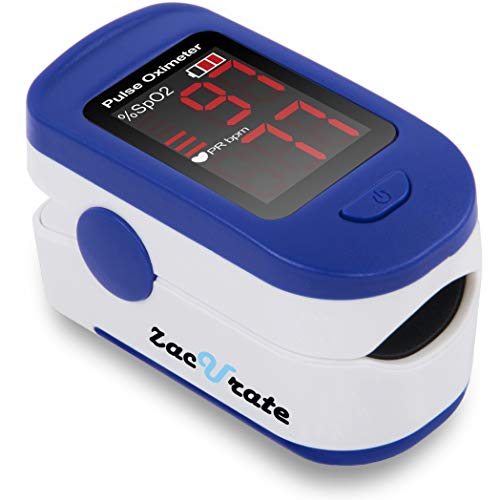
The 500BL is the 2017 sibling of the 500DL. Same SMART Spring System finger chamber, same 10-second SpO2 and pulse rate reading claim, same 1-year warranty, same USA-based technical phone support. Where the 500DL adds a silicone cover and the ability to read SpO2 up to 100%, the 500BL keeps the essentials and lets go of the extras. Weight is 4 oz, the highest published in this set but still lighter than a bar of chocolate. Dimensions run 1.3 x 2.1 x 1.1 in, close to the Zacurate 500DL. Two AAA batteries ship in the box. The colour is a light navy blue that stands out in a bag more than the 500DL's royal black.
The upgrade pitch is straightforward: Zacurate reliability, one price band cheaper than the 500DL. What you give up is the case, the SpO2-to-100% reading claim, and about 0.8 oz.
Pros:
- Same 1-year warranty as the 500DL
- USA-based technical phone support
- 10-second reading claim
- Two AAA batteries in the box
- The second-cheapest here
Cons:
- No silicone case
- No perfusion index or waveform
- 4 oz, heaviest published weight
6. HealthTree JKS50B — Best minimal setup
The JKS50B is the pick if you want one button, pre-installed batteries and a fast reading claim, without paying premium.

Best for: someone who wants a one-button device with pre-installed batteries Skip it if: you want a stated weight or a released date
HealthTree's JKS50B leans hard on simplicity. One button. Press once, insert the finger, wait 5 to 8 seconds. HealthTree claims a ±2% accuracy figure for both SpO2 and pulse rate, and displays SpO2, pulse rate, signal strength and a waveform bar graph on a bright OLED screen. The AAA batteries are pre-installed, which is the small detail that separates a device you use out of the box from one that waits on the counter until you find a screwdriver. Dimensions are 1.25 x 2.25 x 1.2 in, right in the middle of the set. HealthTree ships a lanyard and instruction manual alongside. The listing publishes a 1-year manufacturer warranty.
The gaps are informational rather than mechanical: no weight, no release date. As a device it looks solid; as a spec sheet it leaves the last two rows blank.
Pros:
- Batteries pre-installed
- 5-8 second reading claim
- ±2% accuracy claim on SpO2 and pulse
- Waveform bar graph on OLED display
- 1-year manufacturer warranty
Cons:
- No published weight
- No release date on the listing
- Sells slower than the top picks here
7. HealthTree Fingertip Pulse Oximeter — Best budget pick
This HealthTree is the cheapest of the seven and covers the essentials for a first-time buyer.

Best for: a first-time buyer testing whether they'll use one at all Skip it if: you need perfusion index or a fast 5-8 second reading
The entry-level HealthTree listing shares the JKS50B model number but strips back the marketing to the essentials: SpO2, pulse rate, signal strength, a waveform bar graph on a bright OLED, one-button operation. The unit measures 1.25 x 2.25 x 1.2 in and ships with two AAA batteries, a lanyard and a manual. HealthTree publishes a 1-year manufacturer warranty on this listing too. What's missing here compared to the JKS50B is a stated reading time and a stated accuracy figure. Neither is a fatal loss, but if 5 to 8 seconds mattered enough to name it on one listing, its absence on the other is worth noticing.
This is the cheapest of the seven, and it's the right pick for someone who wants to find out whether they'll actually use a pulse oximeter before spending more. If the answer is yes, the JKS50B or 500BL is where you go next.
Pros:
- The cheapest of the seven
- 1-year manufacturer warranty
- OLED display with waveform
- Batteries and lanyard included
- One-button operation
Cons:
- No stated reading time
- No accuracy figure on the listing
- No perfusion index
Reading SpO2 during and after training
A few things to know before you start using any of these devices in a training context.
- Stay still during the read. Zacurate says it directly on the 500BL listing: movement affects accuracy. Every device here uses the same optical method, so the same rule applies.
- Check before and after, not during. These are spot-check devices with a finger clip. A running SpO2 during exercise needs a wrist sensor or a chest strap, and that's a different category of product.
- Warm the finger. Cold hands after an outdoor session vasoconstrict, and the reading drops or fails. A perfusion index reading, if your device shows one, tells you whether the trace is strong enough to trust.
- Take three reads, not one. A single SpO2 snapshot can miss by a percentage point or two. Three consecutive reads with the same posture and finger give a truer picture.
- Note the context. SpO2 at sea level looks different from SpO2 at 8,000 ft. If you use one at altitude, the drop is expected and does not mean the device is broken.
None of this is exotic. It's the same protocol any home reading needs, applied to a sport context where you're more likely to be cold, sweaty, or mid-breath.
What the listings do not tell you
Three things you'd want to know that the listings here mostly skip.
- Skin tone sensitivity. Fingertip pulse oximeters use light through tissue, and calibration on darker skin has been a documented concern in the medical literature. None of these listings addresses it. If you know your reads have been off on other devices, no product page here promises a difference.
- Nail polish and false nails. Optical readings pass through the fingernail, so polish and acrylics change what the sensor sees. Every device here works the same way, and none of the listings offers a workaround beyond removing polish.
- Battery life in hours. Every pick ships with two AAA batteries. Not one publishes an expected hours-of-use figure. The HOLFENRY listing's auto shut-off after 8 seconds is the closest any listing gets to a battery-life claim.
Assume none of these devices is a substitute for medical advice. They are consumer wellness tools, and every listing here presents itself as such.
The verdict
If you want the most complete package in this set, the Zacurate 500DL is the pick. It's the only one that ships with a silicone cover, and it publishes the full spec sheet a buyer wants: 3.2 oz, 1-year warranty, USA-based phone support, a 10-second reading claim, and two AAA batteries in the box.
If you want more on the screen than SpO2 and pulse rate, the Innovo Deluxe iP900AP is the better buy. It's the only pick here that combines a plethysmograph waveform, a perfusion index and an adjustable auditory alarm, and it's aimed at exactly the "climbers, skiers, bikers, aviators" use case that brings athletes to this category.
If neither of those matters and you just want to see whether you'll use one at all, the HealthTree budget pick is the cheapest of the seven and covers the essentials with a 1-year warranty. That's the two-track answer: 500DL as the default, iP900AP when the extra readings decide it, HealthTree when you're not yet sure. Everything else in this set falls in between.
FAQ
What does a pulse oximeter actually measure for athletes?
A pulse oximeter measures blood oxygen saturation, or SpO2, and pulse rate through a fingertip clip. For athletes, that means a quick check of oxygen levels before a session, after a hard interval, or at altitude. Some picks here also display a perfusion index, which is a strength-of-signal figure, and a plethysmograph waveform, which is a visual pulse trace.
Is a pulse oximeter worth it for training?
A pulse oximeter is worth it if you train at altitude, do breath-work, or want a data point on recovery mornings. For a sea-level runner who checks resting heart rate on a watch already, the added information is small. The Zacurate 500DL is the fullest package here, and the HealthTree budget pick is the low-cost way to find out whether you'll use one before committing.
Can I wear a pulse oximeter during a run?
You cannot wear any of the seven picks here during a run. They're fingertip clip devices, not wrist wearables, and every listing here specifies stillness during the reading. Zacurate says on the 500BL page that movement affects accuracy. For continuous SpO2 during exercise, a wrist-worn wearable with an SpO2 sensor or a chest strap with the same feature is the right category.
Zacurate 500DL versus Innovo iP900AP, which for altitude?
Between the Zacurate 500DL and the Innovo iP900AP at altitude, the Innovo wins on features and the Zacurate wins on packaging. Innovo's perfusion index and improved sensor are aimed at low-perfusion reads, which happen when your fingers are cold. Zacurate's silicone cover and lighter 3.2 oz body are aimed at surviving the trip up. Pick the Innovo for the data, the Zacurate for the durability.
What's the biggest mistake buying a pulse oximeter for sport?
The biggest mistake buying a pulse oximeter for sport is treating reading speed as the deciding specification. A 5-8 second reading and a 10-second reading feel the same in practice. What actually decides it is what appears on the screen: a perfusion index tells you the reading is trustworthy, a waveform confirms the pulse is real, and a case decides whether the device survives your bag.
Start with the Zacurate 500DL if you want the fullest published spec sheet and the only silicone cover in the set. Move to the Innovo iP900AP if the extra readings on screen decide it: plethysmograph, perfusion index and an alarm you can set. The reason the 500DL is the default here has less to do with what it does during a reading and more to do with what it does the other 23 hours of the day, when it's living in a gym bag with your keys and a spare band. A device that survives is a device you actually use, and everything else here trusts you to keep the plastic somewhere kinder.